What you need
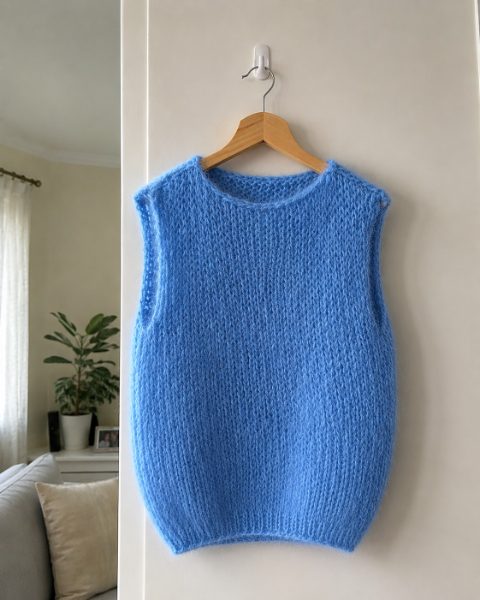
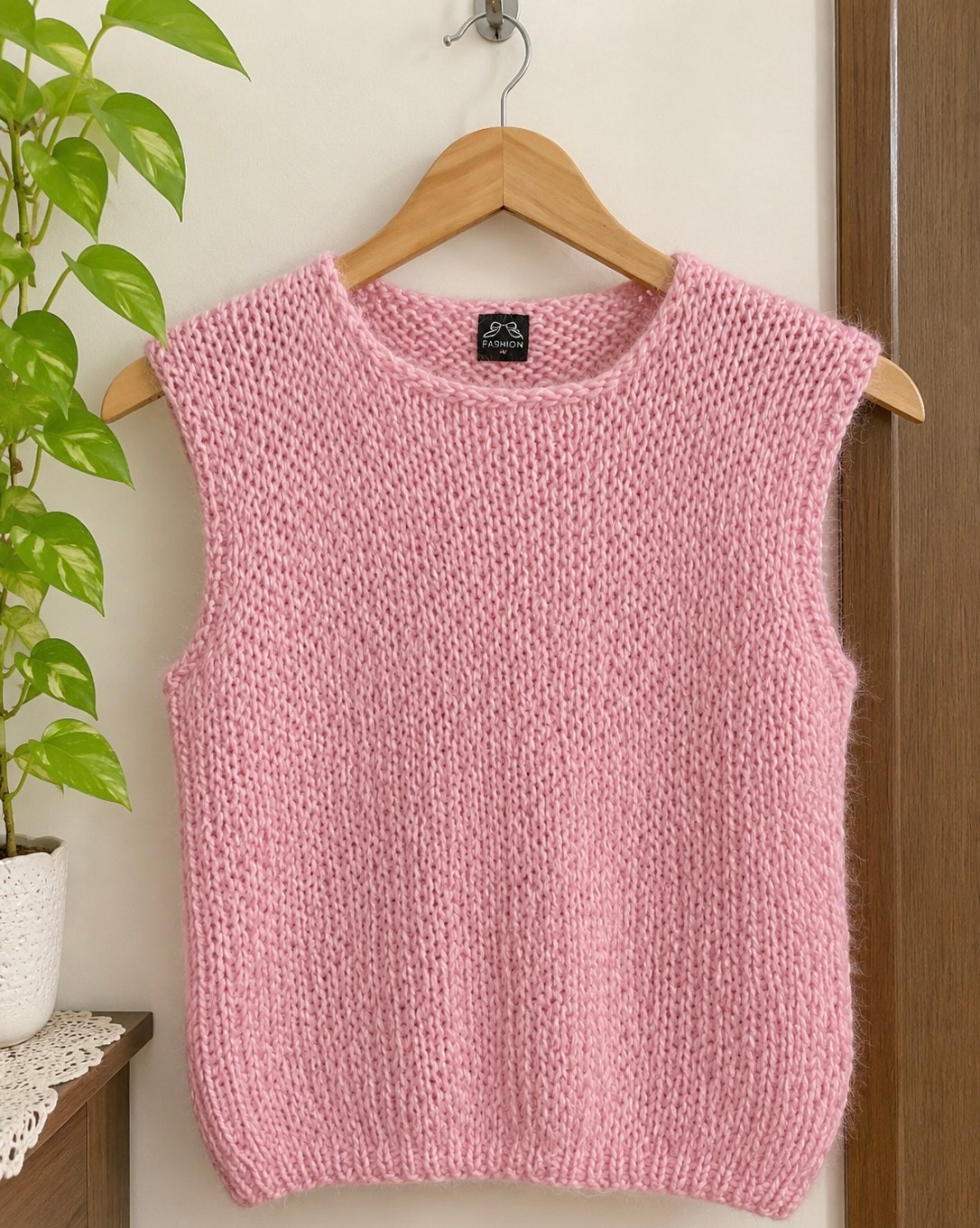
| Sizes | XS, S, M, L, XL and 2XL — finished chest 28 to 48 inches with 2 inches of ease at every size. Cropped and boxy: lengths 15 1/2 to 25 3/4 inches, shoulder to hem. The vest photographed is size XS. A vest is worn over a shirt, so choose by chest measurement. |
|---|---|
| Yarn | A chunky (bulky) wool or wool-and-mohair blend, about 120 yd / 110 m per 100 g ball, in blush — 3 to 6 balls depending on size (260 to 690 yards). A vest this plain lives or dies by its yarn: something with a little halo keeps a big field of stockinette from looking flat. Yardage is counted stitch by stitch from the pattern itself, with 8% allowed for swatching and finishing. |
| Needles & notions | A US 11 (8 mm) circular, 24 in / 60 cm, for the body — in the round to the underarm, then back and forth for the two halves. A US 10 1/2 (6.5 mm) for the hem if your rib tends to flare, and two US 11 double-pointed needles for the i-cord. Two markers, a spare needle for the shoulder joins and a blunt tapestry needle. |
| Gauge (tension) | 14 stitches and 18 rows = 4 in / 10 cm in stockinette on US 11 (8 mm), blocked. Measure the rows as carefully as the stitches: the armhole, the neck and the whole length of this vest are counted in rows, not inches. |
Skills you’ll use
- Knit and purl — a 1x1 rib hem and plain stockinette, nothing else in the fabric
- Knitting in the round to the underarm, then working the two halves flat
- A barely-there armhole: a small underarm bind-off and two to four decreases a side
- Shaping a neck, written out row by row for the front and the back
- Joining the shoulders with a three-needle bind-off
- Picking up stitches round an opening
- The applied i-cord — one row, repeated until the opening is used up, taught with a stitch-by-stitch diagram
What’s in the PDF
- 13-page PDF, fully graded for six sizes, XS to 2XL
- Full-page photographs of the front and the back
- Finished measurements for every size, plus every stitch and row count
- A stitch-by-stitch diagram of the applied i-cord
- The front and the back drawn flat, side by side, and a measured schematic with the reasoning behind every proportion
- Row-by-row instructions: hem, body, back, front, shoulders and all three i-cord edges
- Finishing, blocking and a troubleshooting table
Questions about this pattern
I've never worked an applied i-cord. Is it difficult?
No — it is the simplest edging there is. You cast on 3 stitches and repeat a single row until the opening is used up: knit 2, work the last cord stitch together with one picked-up stitch, slip all 3 back. Because every row eats exactly one picked-up stitch, the cord cannot come out too long or too short, and the pattern includes a stitch-by-stitch diagram of the whole motion.
Will the neck really fit over my head? There's no stretchy neckband.
Yes — and the pattern is drafted around exactly that question. An i-cord edge does not stretch, so the neck is cut wide and shallow on purpose: 18 1/4 inches round relaxed at the smallest size, before the fabric's own give. That wide, shallow scoop is also what gives the vest its look.
What yarn should I choose?
A chunky wool or wool-and-mohair blend, about 120 yd / 110 m per 100 g. The vest is plain stockinette from hem to shoulder, so the yarn has to carry it: a little halo, as in the photographs, keeps the big plain field from reading flat. One colour, and buy it all in a single dye lot.
Is this suitable for a beginner?
Yes. There are no sleeves, no side seams and no chart — a rib hem, a straight tube, two plain halves and three cords. Both necklines are written out row by row, so if you have never shaped a neck before, this is a forgiving place to learn.